Can We Still Trust Our Eyes?
Over the past several weeks, a pattern surfaced from the noise of my LinkedIn feed. A simple question, “Which one is AI?” sparked a massive conversation that reached far beyond my immediate circle. From a nostalgic deep dive into 1990s “Glamour Shots” to high-stakes cybersecurity keynotes, thousands of professionals have been putting their visual intuition to the test.
With the “Glamour Shots” post alone generating over 13,000 impressions, it is clear that we are collectively fascinated by the blurring line between the synthetic and the authentic. As a storyteller, I wanted to go beyond the “gotcha” moment. By analyzing the engagement from our community spanning industries from IT to Marketing, I’ve distilled five core truths about how we perceive reality in the age of generative AI.
Lesson 1: The Uncanny Valley of Perfection
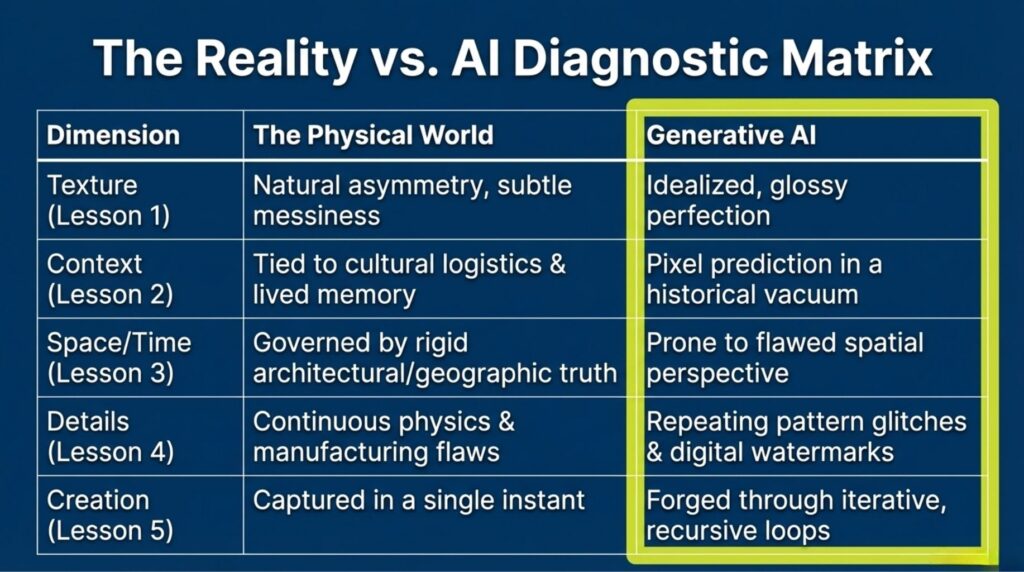
The most consistent “tell” that gives the ghost in the machine away isn’t a glitch, but a lack of messiness. In our physical world, reality is defined by subtle imperfections: the way light catches a stray hair or the natural asymmetry of a smile. AI, by contrast, tends toward an idealized perfection that the human brain instinctively flags as “off.”
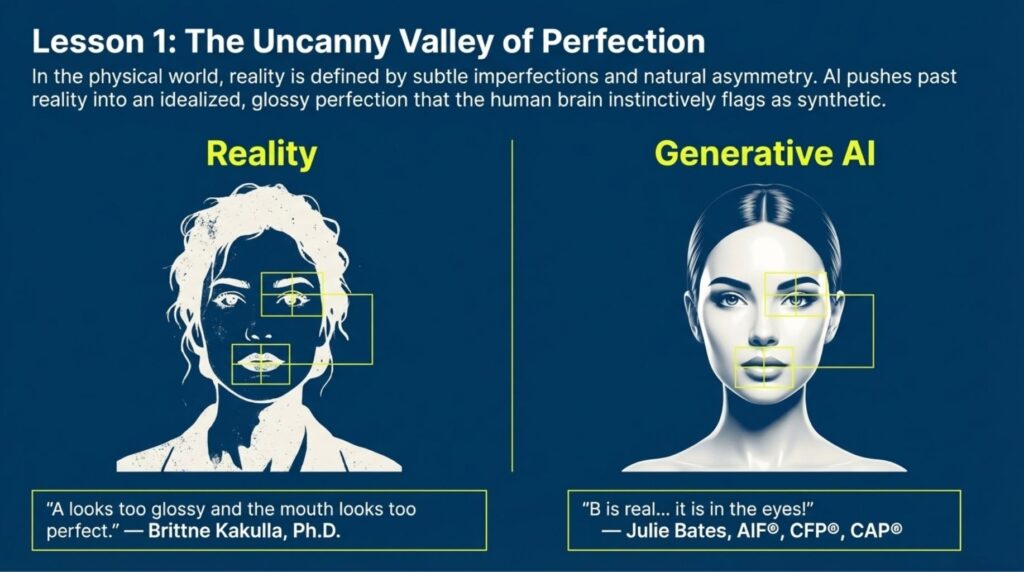
A clear consensus emerged across the experiments. Julie Bates, AIF®, CFP®, CAP® noted that the truth is often hidden “in the eyes,” while Brittne Kakulla, Ph.D. observed that “the mouth looks too perfect” in synthetic renderings. This sentiment was echoed by Robert B. and Xavier Williams, who both identified a specific texture that separates the two.
“A looks too glossy and the mouth looks too perfect.” — Brittne Kakulla, Ph.D.
“A is AI. You can notice the glossy look.” — Robert B.
Lesson 2: Lived Experience is the Ultimate Filter
The “Glamour Shots” experiment (Jan 6, 2026) proved that nostalgia is more than a feeling—it’s a forensic tool. Those who lived through the era were nearly impossible to fool because they remember the specific “vibe” and, more importantly, the technical limitations of the time.
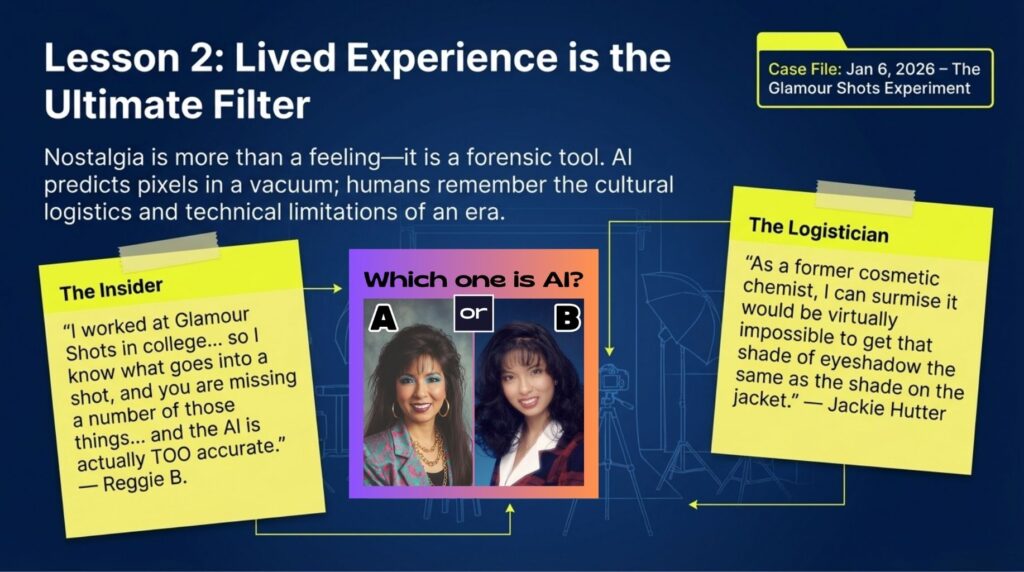
AI understands what a “jacket” and “eyeshadow” look like in a vacuum, but it lacks the cultural texture of the 1980s mall studio. Reggie B, who actually worked at a Glamour Shots studio, spotted discrepancies in the “getup” that the AI’s training data simply couldn’t account for. Melanie Ostovic relied on her lived experience to spot the fake, while Jackie Hutter identified a hilarious technical impossibility: the idea that a 1988 mall studio could perfectly match eyeshadow to the specific shade of a jacket. AI predicts pixels; humans remember the logistics of the era.
Lesson 3: The Architecture of Truth (Geography and History)
When we moved to the “New York City Photo from 2000” (Jan 27, 2026), the experiment shifted from facial recognition to logical analysis. AI is a master of aesthetics, but it frequently fails the test of spatial and historical fact.
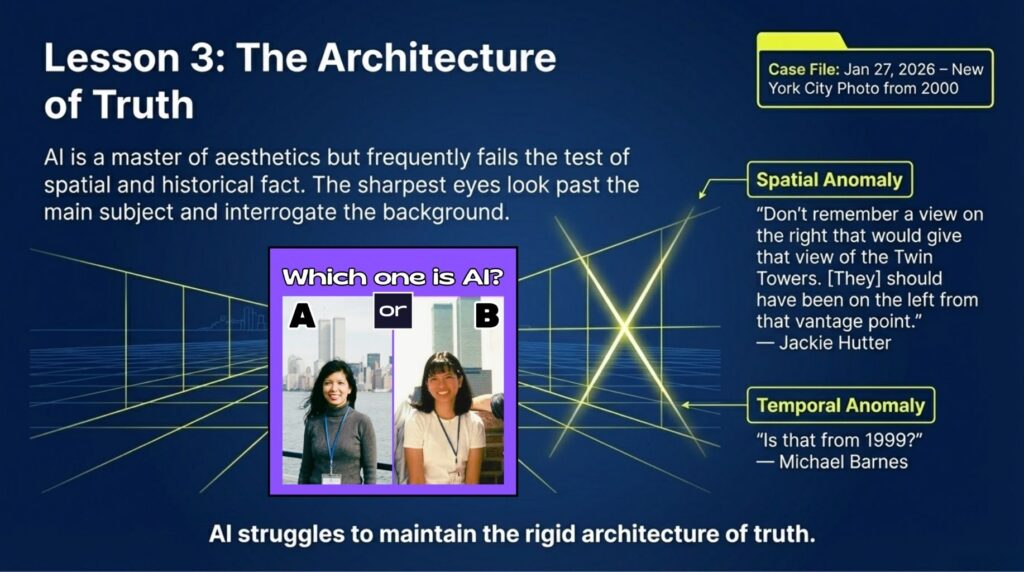
Our community’s sharpest eyes looked past the subject and into the background. Jackie Hutter provided a masterclass in spatial awareness, noting that the perspective of the Twin Towers was fundamentally flawed—they appeared on the right when they should have been on the left from that vantage point. Meanwhile, Michael Barnes questioned the historical timeline itself, asking, “Is that from 1999?” While AI can create a convincing “look,” it struggles to maintain the rigid architecture of truth.
Lesson 4: Hunting for the “Smoking Gun”
While many users rely on “vibes,” others take a forensic approach, hunting for technical artifacts. The “Cybersecurity Speaking” and “Super Bowl” posts highlighted that for the diligent observer, the devil is always in the details—specifically in repeating patterns where the AI’s logic breaks down.
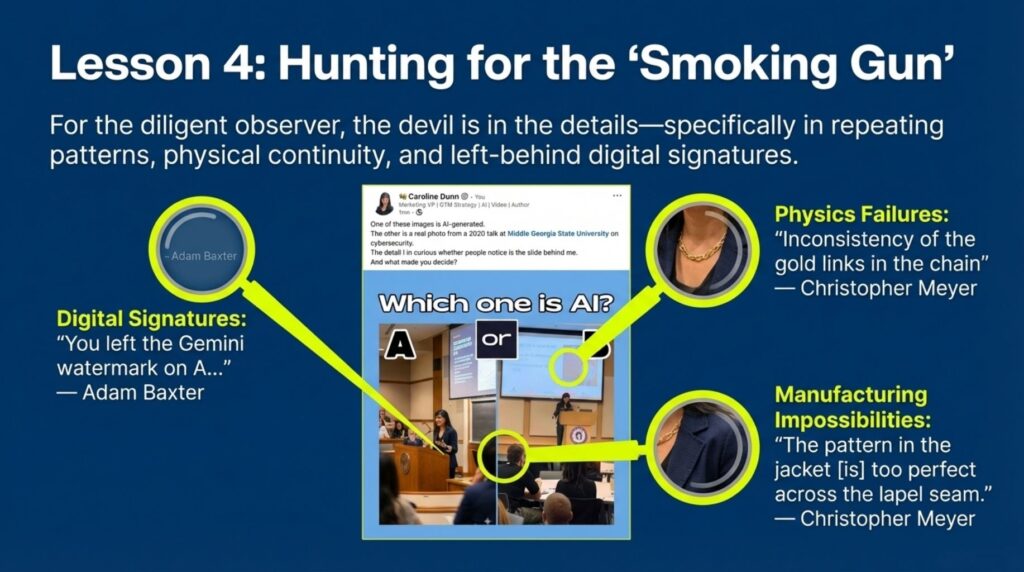
Adam Baxter famously spotted a “Gemini watermark” left behind in one of the images—a literal digital signature of the creator. Others, like Christopher Meyer, looked for inconsistencies in physics and manufacturing. He identified the “too perfect” alignment of a jacket pattern at the lapel seam and irregularities in the gold link patterns of a chain. These tiny glitches are the “smoking guns” of our current era, proving that AI still struggles with the complex continuity of physical objects.
Lesson 5: Prompting is a Strategic, Human-in-the-Loop Craft
One of the most surprising insights came from the “behind the scenes” of the experiment. Many assume AI generation is a “one-click” miracle, but as the Jan 20, 2026 post revealed, it is an iterative, human-led craft.
The most sophisticated strategy I’ve found isn’t writing the prompt myself; it’s a recursive process. I often ask the AI to generate its own prompt based on a concept, then refine and plug that prompt back in to see how the model interprets its own logic.
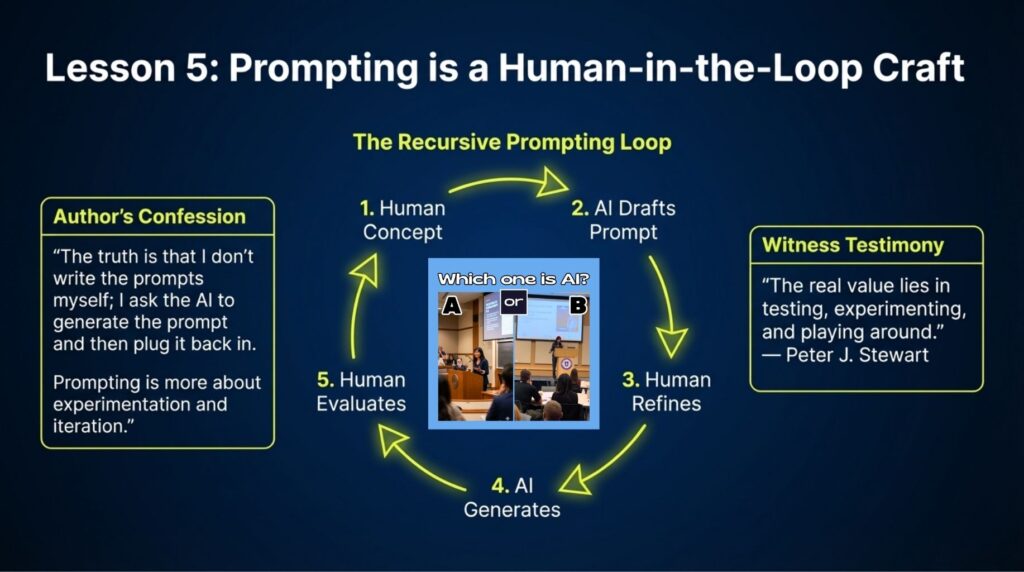
As Peter J. Stewart noted, the real value lies in “testing, experimenting, and playing around” to find those boundaries.
“The truth is that I don’t write the prompts myself; I ask the AI to generate the prompt and then plug it back in. For me, prompting is more about experimentation and iteration,” I admitted.
Conclusion: The Future of Our Visual Reality
The overarching takeaway is clear: while AI is an incredibly powerful tool for creation, the “human eye”—trained by nostalgia, local context, and logical spatial awareness—remains the ultimate judge.
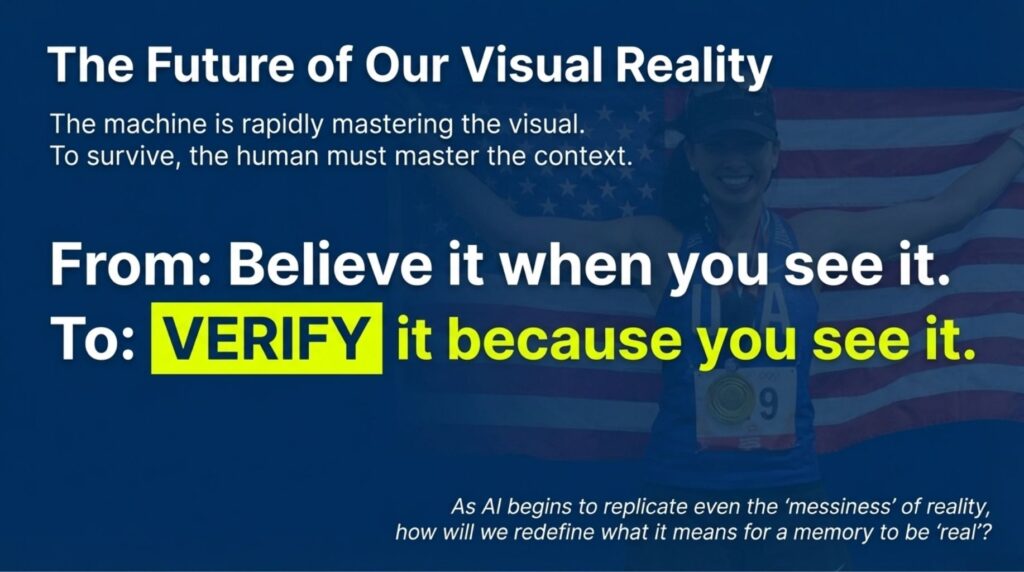
As AI continues to evolve and erase these current “tells,” our definition of authenticity will have to shift. We are moving from a world where we “believe it when we see it” to one where we must “verify it because we see it.”
As AI begins to replicate even the “messiness” of reality, how will we redefine what it means for a memory to be “real”?